Robot-Aware Design and Assembly of Architected Structures
Integrating Computational Design, Structural Functionality, and Robotic Construction for Diverse Engineering Environments.
The Problem
Architected structures enable tailored mechanical and functional properties through geometric and structural design. However, their geometric complexity and assembly requirements create fundamental challenges in fabrication, structural connectivity, and robotic construction.
Our Rationale
We investigate the co-design of structural architectures, modular connections, and robotic assembly processes. By integrating structural performance requirements with robotic capabilities and assembly constraints, we aim to establish generalizable design principles for robot-constructible infrastructure.
01
Architected Structural Design
We investigate computational approaches for designing architected structures with tailored geometric, mechanical, and functional properties. Our research explores how structural configurations can be optimized for application-specific performance while accounting for fabrication feasibility and robotic constructability.
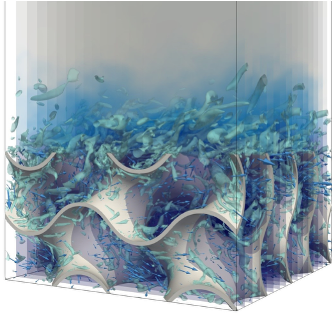
Architected Structural Geometries
Representative structural configurations illustrate how geometric design can enable tailored functionality and modular construction.
A cutaway cube reveals a complex network of curved internal surfaces and openings. The source presents it under New Designs. This is a design rendering; material properties and wave-resistance measurements are not provided in this figure.
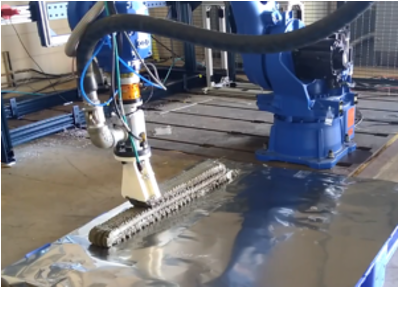
Exploring robotic fabrication approaches for producing architected structural components with complex geometries.
A robotic arm carries a nozzle above a flat work surface with a layered material deposit. The supplied slide places this image under New Materials. The slide does not establish that this photograph shows fabrication of the particular breakwater modules pictured elsewhere.
We investigate connection geometries and modular interfaces that integrate structural requirements with robotic assembly constraints. Our research considers geometric compatibility, alignment, insertion accessibility, and connection stability to support robot-compatible construction.
Modular Connection Strategies
Alternative connection geometries illustrate different approaches to structural integration and robot-compatible assembly.
Three labeled TPMS pairs appear in an elevated view: Diamond on the left, Gyroid in the center, and Primitive on the right. Each pair retains its original slot and tenon geometry. All blocks begin at the same center height. In a staggered sequence, each moving tenon lifts vertically, travels above its stationary partner, pauses over the aligned side groove, and lowers straight down into the nominal seated position. Horizontal position stays fixed during each insertion. The final view compares the three assembled pairs. Family names distinguish them independently of shading. Cast shadows are disabled. The shared motion follows the vertical groove direction; it does not validate manufacturing clearance, contact forces, locking, or strength. Silent visualization. Full text alternatives and timed visual descriptions are provided. Source: Six supplied TPMS STL models: diamond, gyroid, and primitive, each with slot and tenon variants. new CAD-based visualization.
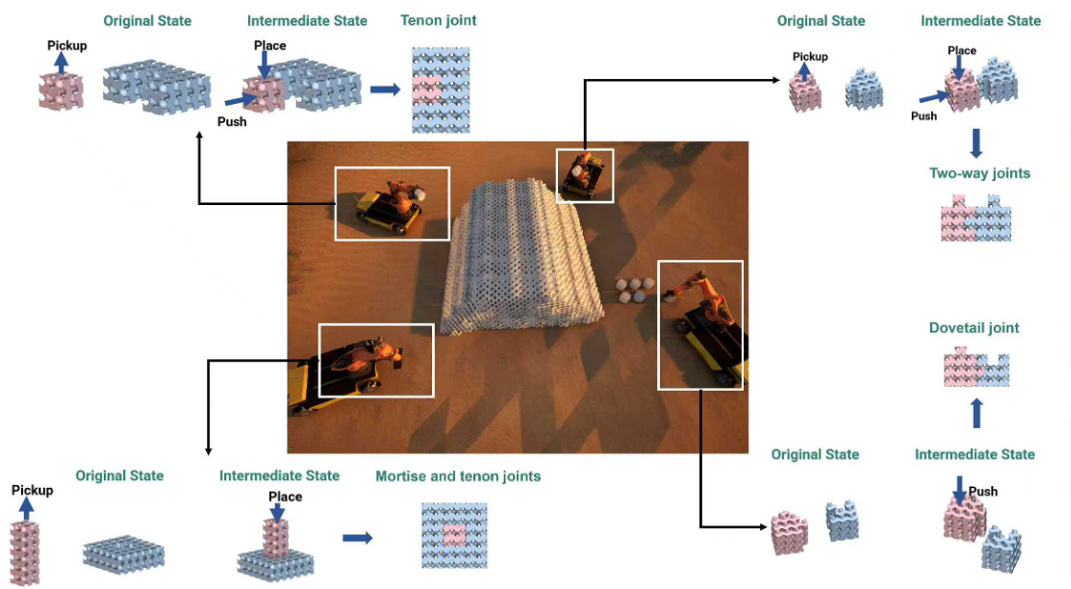
Structural Interface Design
Around a central rendering of robots and a modular structure, small diagrams label Original State and Intermediate State and use Pickup, Place, and Push arrows. The alternatives are labeled Tenon joint, Two-way joints, Mortise and tenon joints, and Dovetail joint. The arrows distinguish lifting, placing, and sliding directions. These are illustrated connection strategies, not recorded assembly trials.
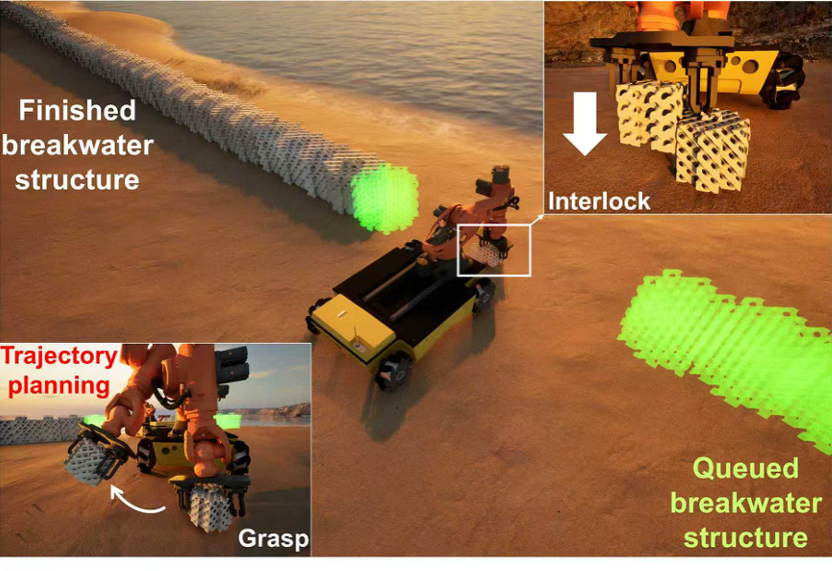
Conceptual demonstrations explore how modular structural systems can be assembled for different engineering environments.
A mobile manipulator stands beside an extended row of interlocking modules along a shoreline. The source labels the completed row as Finished breakwater structure and the planned modules as Queued breakwater structure. Insets show Grasp, Trajectory planning, and Interlock. Text labels distinguish planned and completed parts independently of color. This is a rendered assembly concept, not footage of a constructed coastal installation.
Source: UF Robotics Workshop — Shuai Li, slide 7. Detail extracted from the original composite figure.
03
Robotic Assembly Planning and Execution
We investigate robotic construction strategies for architected modular structures, focusing on manipulation, motion planning, alignment, and sequential assembly.
Our research explores how robotic capabilities and assembly constraints can inform structural and connection design, supporting integrated approaches to robot-aware construction.
Illustrative Robot-Assisted Assembly
Beside a rendered shoreline, a tracked excavator collects six porous TPMS blocks staged at the same center height. For each block, the illustrative clamp closes and lifts vertically. The arm transfers the block above the growing row, keeping its lower edge clear of the placed partner. After a brief alignment pause above the vertical side groove, the block lowers straight down with no horizontal movement during insertion. The clamp opens only after the block reaches its nominal seated position, then withdraws upward. The machine repositions and repeats the sequence, forming a seven-module segment with the starter block. The camera moves toward the water side for the completed view. Six outlined markers and named phases identify progress without relying on color. The detailed excavator comes from the supplied Unity project; sand textures and beach rocks come from the local Unreal project. Original primitive slot and tenon meshes are retained. Supports, shoreline layout, and water are illustrative. This is prescribed kinematic motion, not a contact-force or wave-response simulation. Silent visualization. Full text alternatives and timed visual descriptions are provided. Source: Supplied Excavator02 model from Unity test02; Brushify beach assets from the local Unreal project; original TPMS primitive STL models. new CAD-based visualization.
Research Vision
Our long-term goal is to establish a generalizable framework for the co-design of architected structures and robotic construction, enabling adaptable structural systems for applications ranging from coastal infrastructure to extraterrestrial construction.