Dull
80%
of riggers, the workers who attach and guide crane loads, make repetitive motions for more than half of their working time.
Source ↗Workers in hard hats and high-visibility vests guide a precast concrete footing suspended from crane slings onto a prepared concrete slab. They walk beside it with their hands on it as it is lowered. Close views then show workers crouched against the footing, pressing it with gloved hands to seat it on its guide hardware.
A real Unitree G1 humanoid running HOIST faces a gray box suspended from slings above a wooden platform with an outlined target. As the box is lowered, the robot reaches forward and pushes it with its hands, and the box lands on the platform. Fully autonomous, at original speed, without audio.
80%
of riggers, the workers who attach and guide crane loads, make repetitive motions for more than half of their working time.
Source ↗64%
of riggers work exposed to contaminants such as dust, gases, or odors every day.
Source ↗297
U.S. workers died in crane-related incidents from 2011 to 2017.
Source ↗349,000
new workers U.S. construction must attract in 2026 to keep up with demand, most of them to replace retirees.
Source ↗A worker in a high-visibility jacket presses one palm against the edge of a tall bulkhead gate section suspended from crane slings beside a concrete wall, while a second worker walks up from the far side of the section.
Two workers in hard hats raise their arms and press gloved hands against a precast concrete beam suspended from crane slings between two columns. A close view then shows their hands on both ends of the beam as they align it above a column.
A worker in a hard hat rests a gloved hand on a crane-suspended precast concrete wall cap and guides it along a brick wall as it is lowered.
A shipyard rigger with a coil of line over one arm holds a tagline attached to a submarine bow plane suspended from a dockside crane, adjusting the line as the load travels overhead. The wide-angle camera follows the rigger.
A worker in an orange vest holds a tagline attached to a compact track loader suspended from crane slings, keeping the line in hand as the machine moves just above a cleared slope.
A worker in a white hard hat reaches under a precast concrete column section and keeps a gloved hand pressed against it as it is lowered onto the section below, then releases it when the joint has nearly closed.
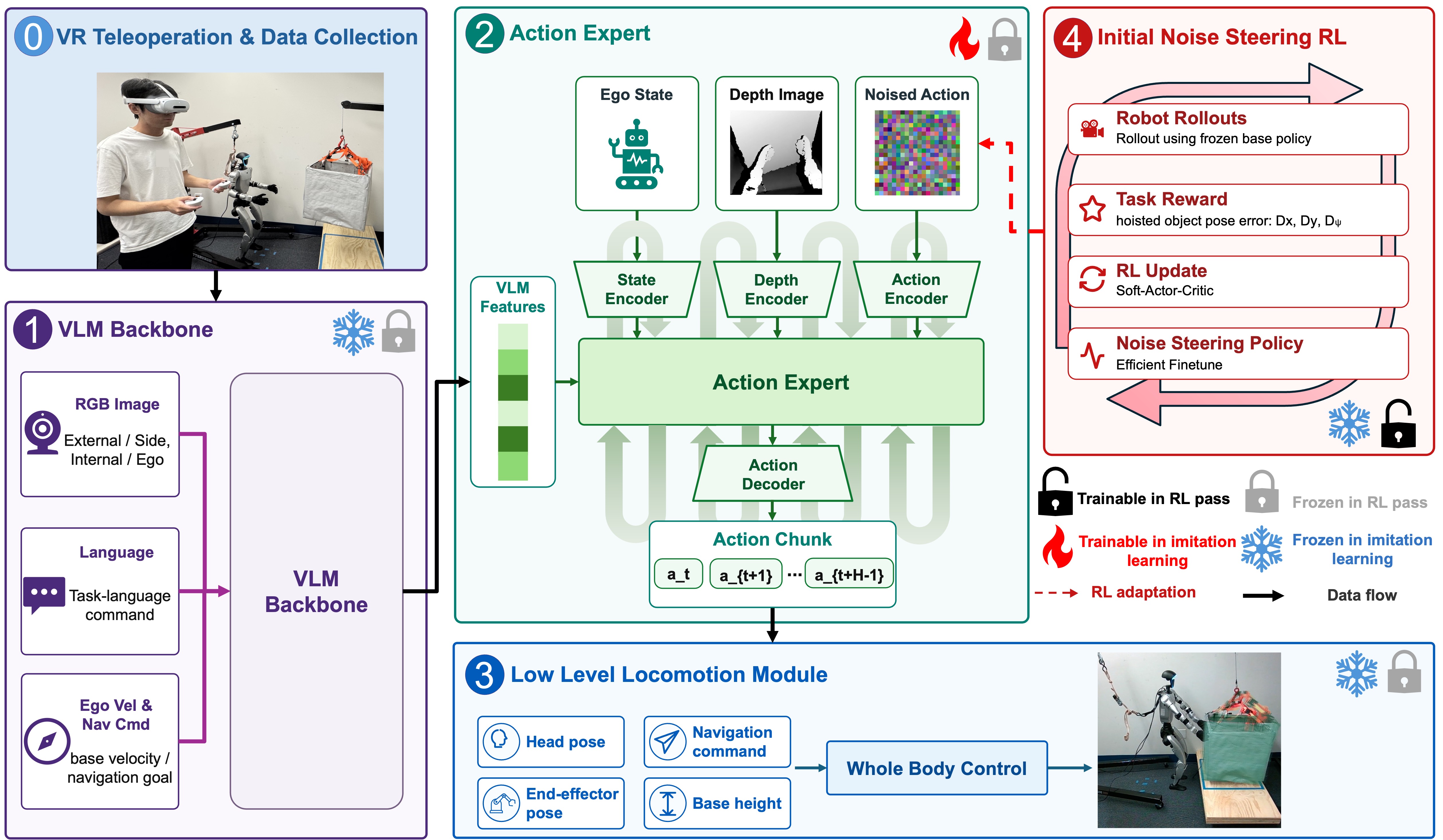
VR demonstrations provide the initial behavior. Ego-view RGB, side-view RGB, language and navigation commands condition the vision-language backbone. Robot state and depth are encoded for the flow-matching action expert, which outputs a 24-step chunk of 25-dimensional planner commands. A frozen whole-body controller executes head, bimanual hand, navigation and base-height targets. During reinforcement learning, a SAC actor steers initial noise using batches of 10 autonomous rollouts and terminal position and yaw rewards; the VLA and controller remain frozen.
Figure panel 0 Teleoperated demonstrations. An operator teleoperates the humanoid with a VR headset and controllers. We collected 50 demonstrations.
Figure panels 1–2 Imitation learning. We finetune the GR00T N1.6 vision-language-action (VLA) policy on those demonstrations. Its inputs are RGB images, a language instruction, navigation commands, depth, and proprioception; its outputs are action chunks.
Figure panel 3 Whole-body control. Action chunks set targets for head pose, bimanual hand poses, navigation, and base height. SONIC, a frozen whole-body controller, executes them on the robot.
Figure panel 4 Reinforcement learning. Imitation does not directly optimize final placement. The robot runs batches of 10 autonomous rollouts, each scored by a terminal reward on position and yaw error. A Soft Actor-Critic agent learns to steer the policy’s initial noise. The VLA policy and the controller stay frozen.
A real humanoid running HOIST faces a gray box suspended from slings above a wooden platform with an outlined target. The robot reaches toward the box and adjusts hand contact as the load is lowered, and the box lands on the platform. This is the HOIST panel of the real-platform segment of the authors’ comparison, at original speed and without audio; black gutters and title bands are removed while the robot, load, and target are retained.
The final phase of a HOIST simulation. A cable-suspended box descends toward a rectangular platform as the humanoid adjusts hand contact and stance, and the box settles into its final position and orientation. Black gutters and title bands are removed; the robot, load, and target are retained at original speed without audio.
@misc{liu2026hoist,
  title  = {HOIST: Humanoid Optimization with Imitation and Sample-Efficient Tuning for Manipulating Suspended Loads},
  author = {Liu, Songyang and Yao, Shunyu and Huang, Dingyuan and Li, Shuai},
  year   = {2026},
  eprint = {2606.00252},
  archivePrefix = {arXiv},
  primaryClass = {cs.RO},
  url    = {https://arxiv.org/abs/2606.00252}
}
Accessibility & video credits · Template: Roman Hauksson · CC BY-SA 4.0