Abstract
This document provides the HOIST training algorithm, additional placement and payload-motion results, and implementation and hardware details.
HOIST Algorithm
Algorithm S1: HOIST Training
Inputs: VR teleoperation demonstrations , pretrained VLA policy (GR00T N1.6), whole-body controller (SONIC, frozen throughout)
Output: Refined hoisting policy
Phase 1 — Supervised Finetuning
Collect VR teleoperation demonstrations with multimodal observations:
Each observation contains ego RGB/depth, side-view RGB, proprioception, ego velocity, navigation command, and language goal
Convert teleoperation commands into VLA action chunks with horizon
Initialize from the pretrained GR00T N1.6 VLA and attach encoders for newly introduced modalities (depth, ego velocity, navigation command)
Supervise the flow-matching action expert to generate demonstration chunks conditioned on VLM features and robot state, using 4 denoise steps
Finetune the final 4 VLM layers, the action expert, and the new-modality encoders on ; keep the remaining VLM backbone and frozen obtain
Freeze and ; cache VLM features for rollout-level RL refinement
Phase 2 — Iterative Batched RL Refinement
Initialize noise-steering SAC actor-critic
For iteration :
Collect autonomous rollouts using
The actor deterministically predicts a replacement initial-noise tensor
Here, 24 is the action-chunk horizon, and 25 is the per-step planner-command dimension covering head target, left/right end-effector targets, navigation command, and base-height command
Replace the flow-matching action expert’s initial noise with the scaled actor output:
Execute the VLA action chunk through the frozen whole-body controller
For each rollout :
Observe terminal payload pose and target
Compute terminal errors:
Compute terminal reward:
Convert rollouts into an offline replay buffer
Train/update with offline SAC on for fixed gradient steps
Resume from previous RL checkpoint for the next stage
Return refined hoisting policy
Design rationale.
During RL refinement, the VLA policy and WBC remain frozen; only the actor-critic is updated. This preserves the imitation-learned visuomotor prior while restricting exploration to the VLA initial-noise space. Each batch of autonomous rollouts is converted into an offline replay buffer, and RL policy is updated with SAC using terminal task rewards. Thus, the method is not tabula-rasa RL, but rollout-level refinement of the frozen VLA flow-matching action-generation trajectory through a compact noise-steering module.
Additional Placement Results
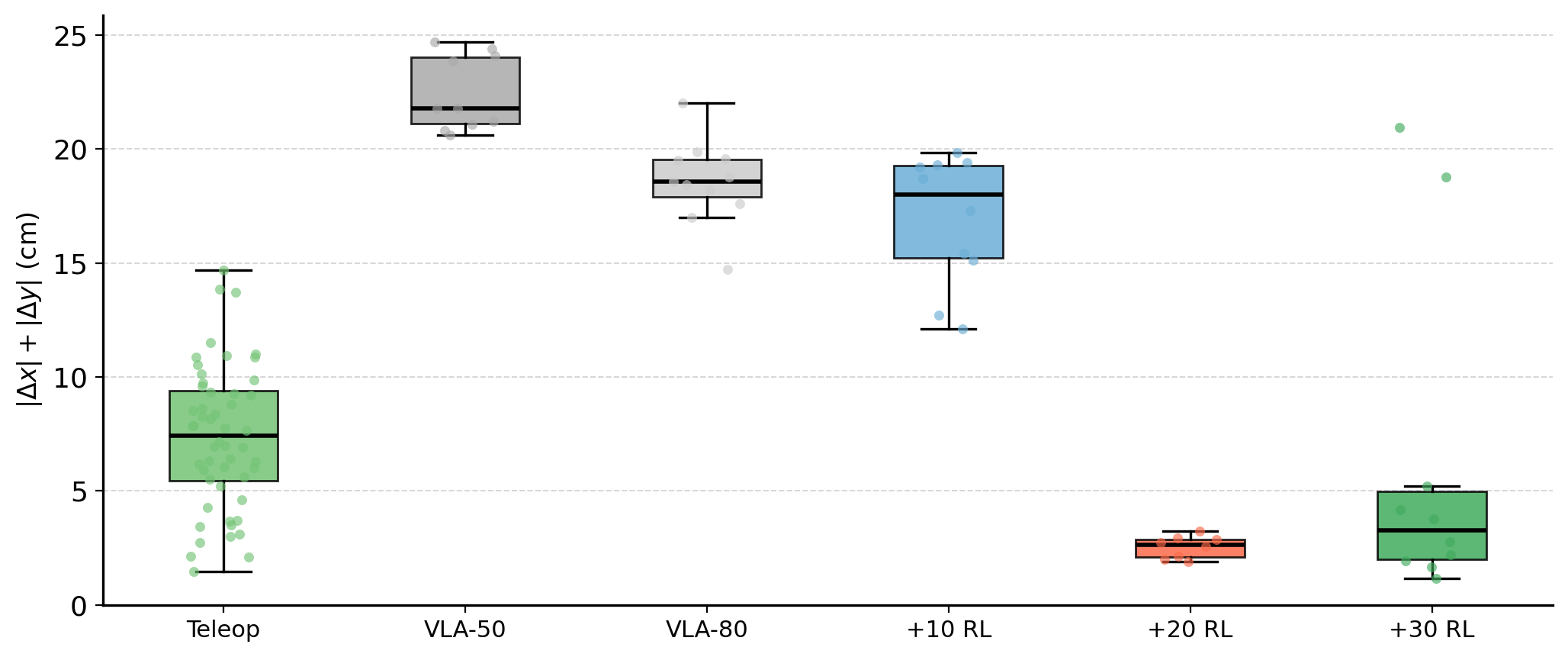
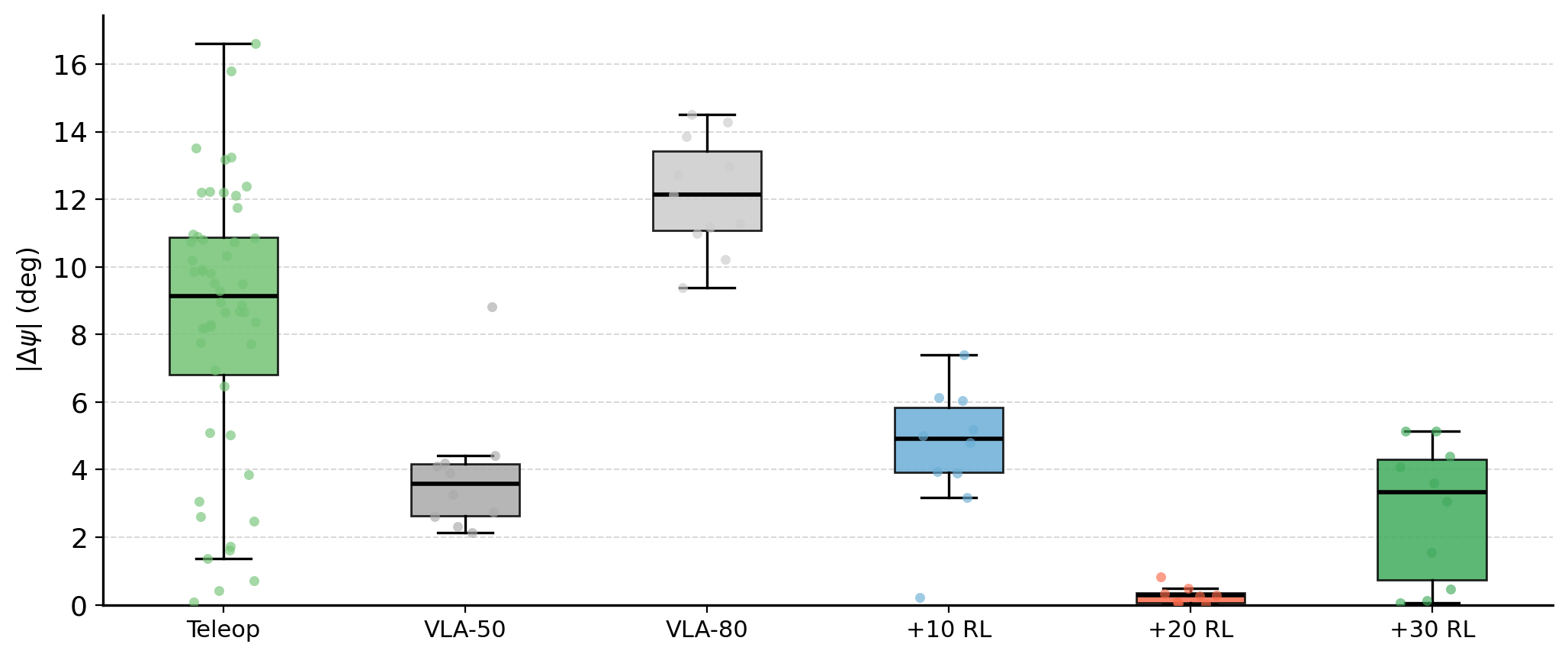
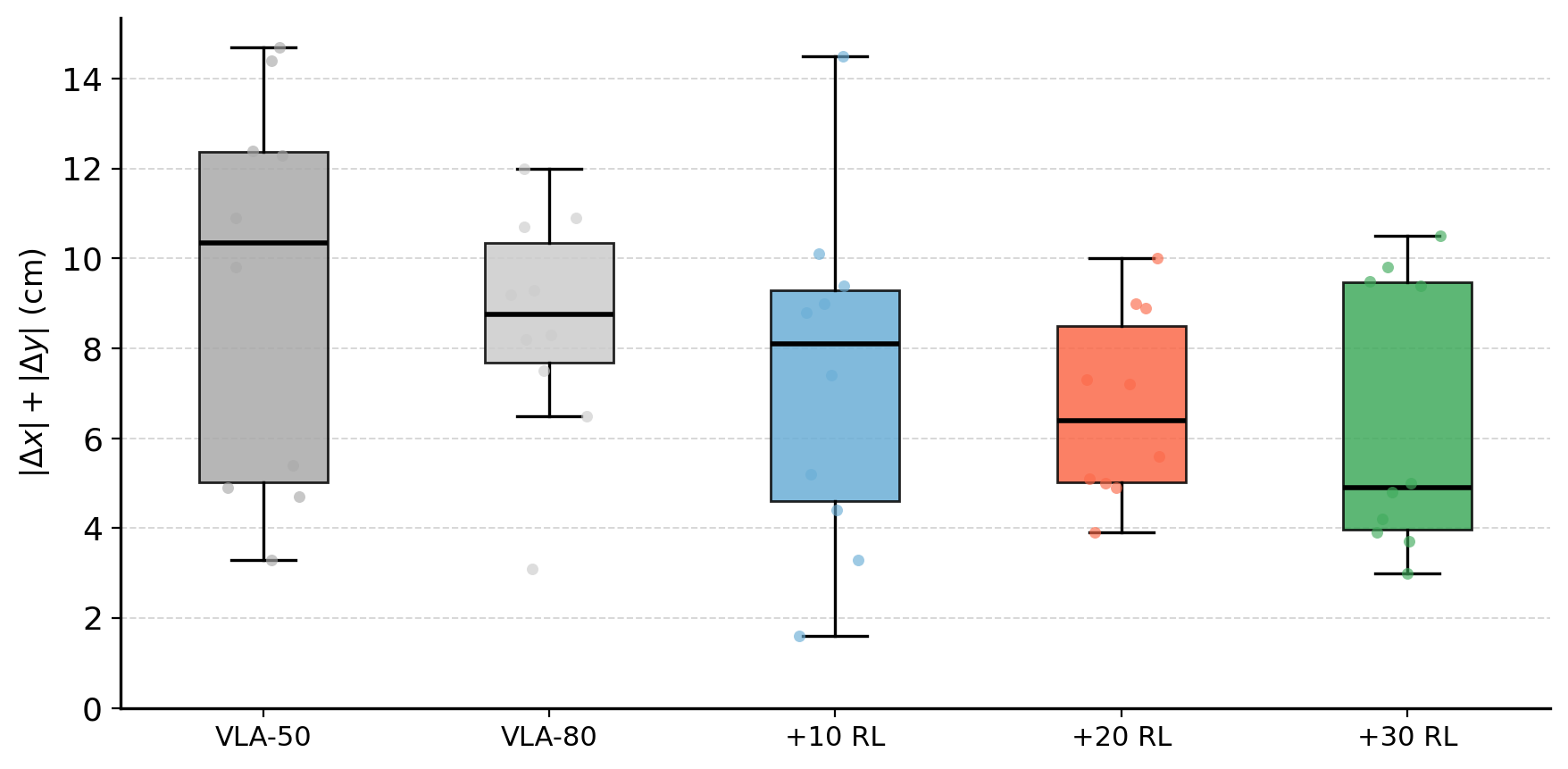
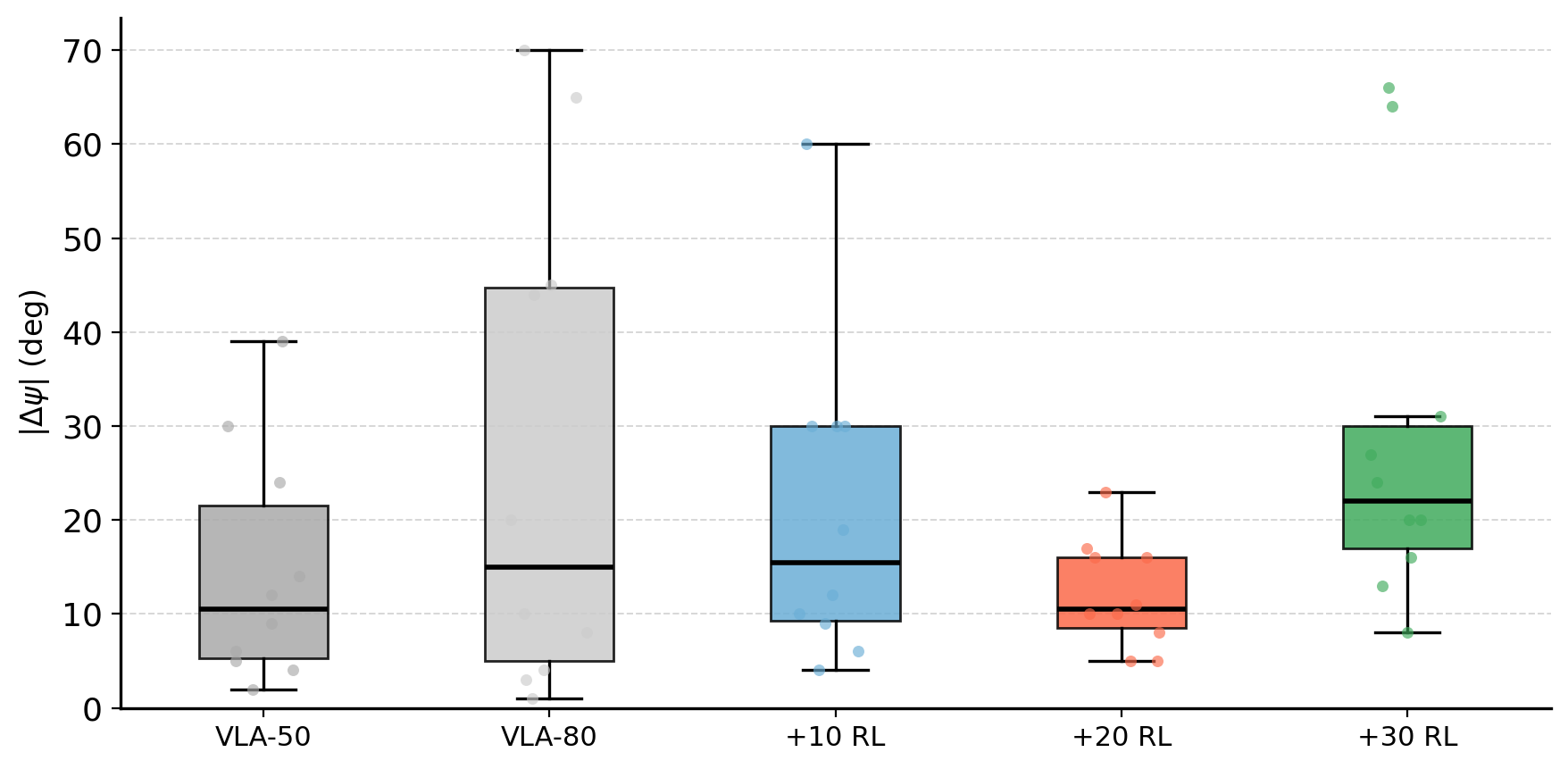
Tables S1 and S2 report terminal placement errors in simulation and on the real platform, respectively. HOIST denotes VLA-50 with iterative batched RL refinement; the rollout count indicates the total RL rollouts used.
Simulation
All three HOIST variants substantially reduce relative to VLA-50. Performance is not strictly monotonic in simulation: HOIST (+20 RL) achieves the lowest mean Manhattan error (2.54 cm), while HOIST (+30 RL) shows a slight increase (6.25 cm). We attribute this to evaluation variance over a small number of trials; on the real platform the mean Manhattan error decreases monotonically (Table S2).
| Method | (cm) | (cm) | () | Manhattan (cm) |
|---|---|---|---|---|
| Human Expert Teleop | 4.35 2.67 | 3.00 1.78 | 8.48 3.99 | 7.35 3.14 |
| VLA-50 | 21.56 1.20 | 0.88 0.94 | 3.85 1.94 | 22.44 1.63 |
| VLA-80 | 15.69 2.18 | 2.89 0.58 | 12.14 1.69 | 18.58 1.84 |
| HOIST (+10 RL) | 15.09 3.53 | 1.83 0.91 | 4.58 1.97 | 16.92 2.89 |
| HOIST (+20 RL) | 1.72 0.57 | 0.82 0.37 | 0.29 0.27 | 2.54 0.48 |
| HOIST (+30 RL) | 5.16 7.11 | 1.09 0.57 | 2.76 2.04 | 6.25 7.30 |
Real Platform
On the real platform, HOIST reduces mean Manhattan error from 9.28 cm (VLA-50) to 6.38 cm (+30 RL), indicating improved translational placement. However, yaw remains high-variance: +20 RL improves mean yaw relative to VLA-50, whereas +30 RL has larger mean yaw error. We therefore interpret the real-platform gains primarily as improvements in translational placement and Manhattan error, rather than as monotonic orientation refinement.
| Method | (cm) | (cm) | () | Manhattan (cm) |
|---|---|---|---|---|
| VLA-50 | 1.60 1.46 | 7.68 3.16 | 14.50 12.46 | 9.28 4.32 |
| VLA-80 | 0.54 0.29 | 8.03 2.55 | 27.00 26.64 | 8.57 2.54 |
| HOIST (+10 RL) | 2.15 1.50 | 5.22 3.72 | 21.00 17.09 | 7.37 3.81 |
| HOIST (+20 RL) | 4.20 1.26 | 2.49 1.35 | 12.10 5.78 | 6.69 2.09 |
| HOIST (+30 RL) | 1.64 0.98 | 4.74 3.52 | 28.90 20.15 | 6.38 3.01 |
IMU Residual Motion Analysis
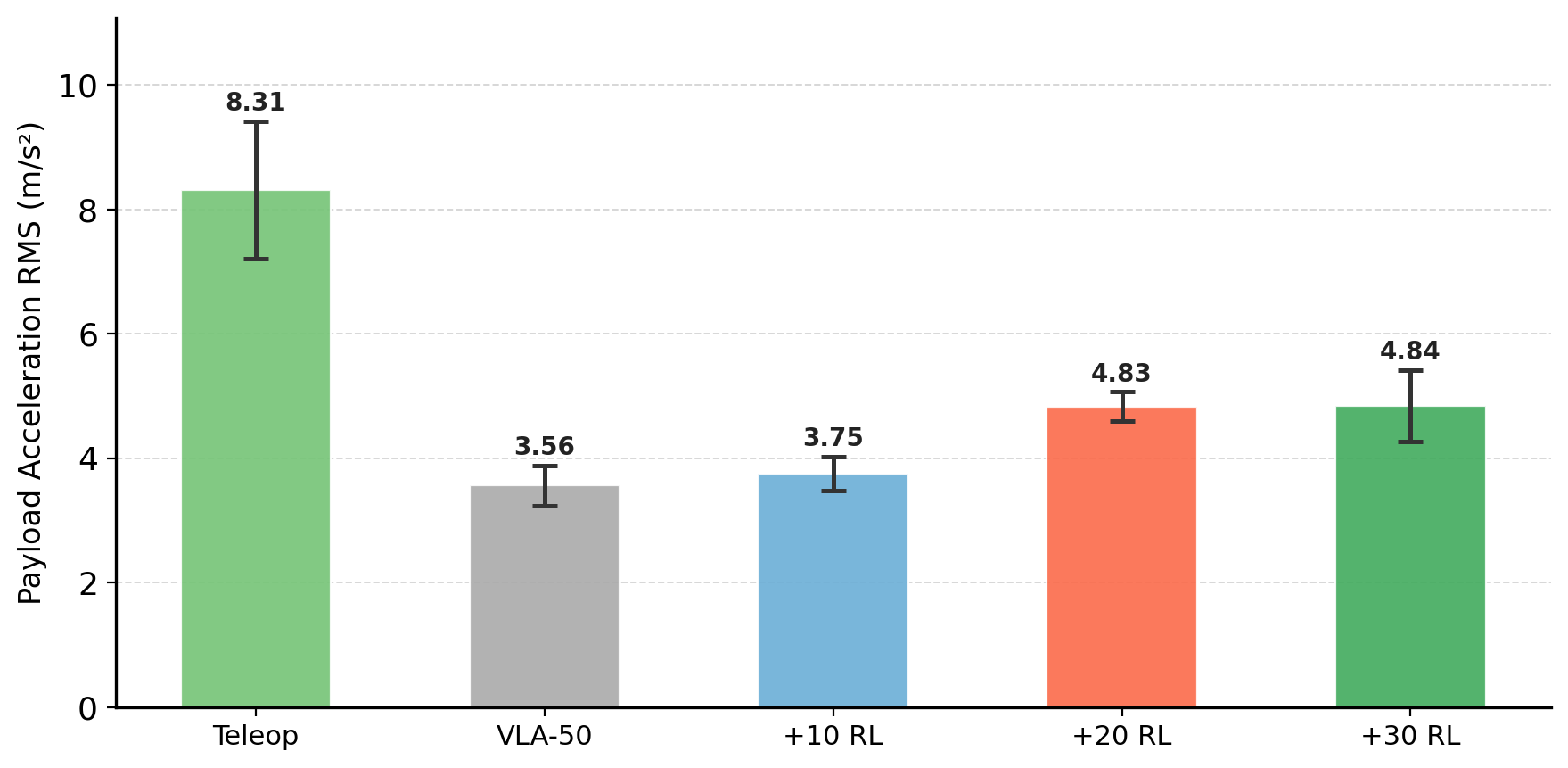
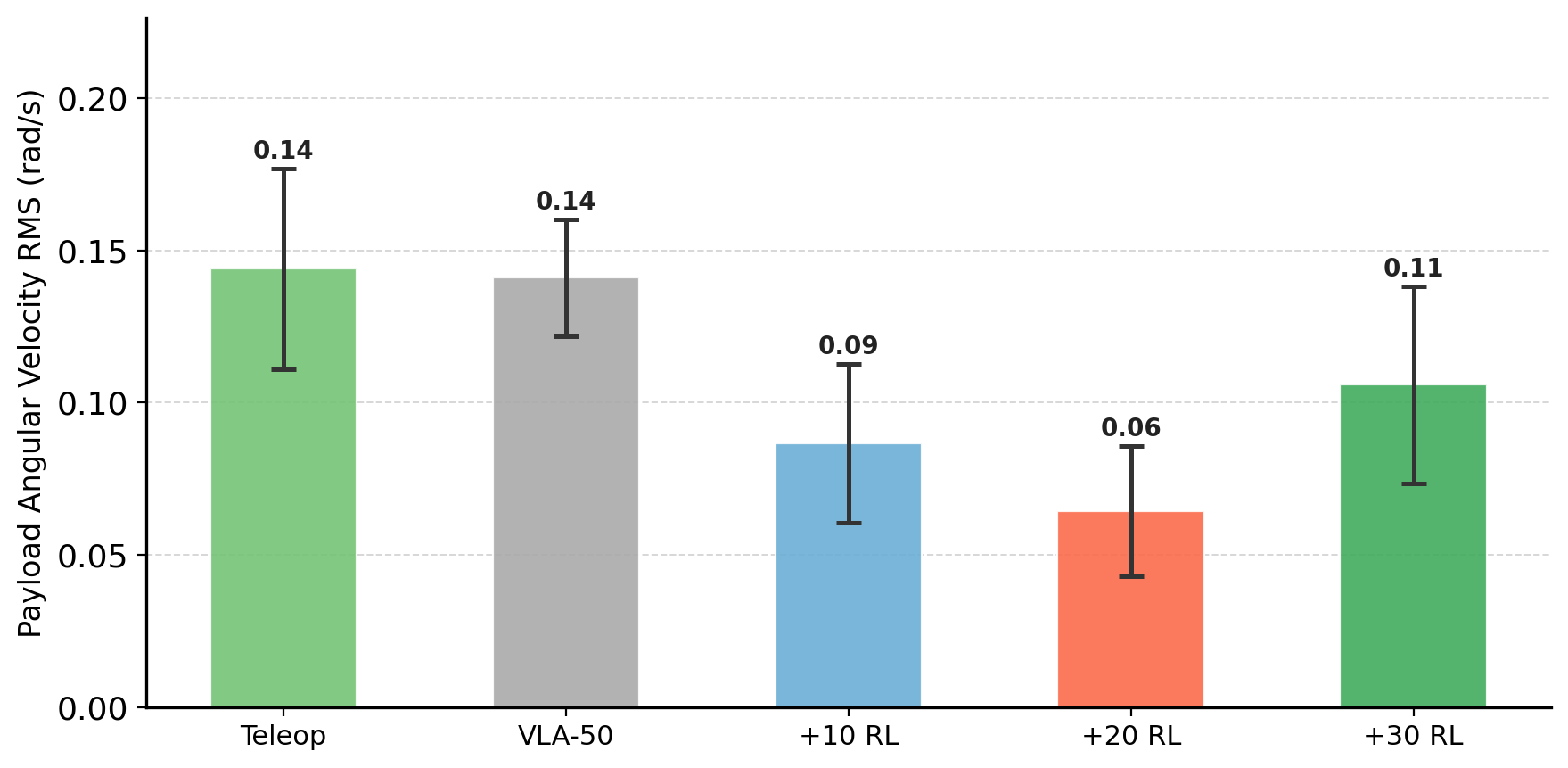
IMU data were collected in simulation only. We attach a 6-axis IMU to the payload and record accelerometer and gyroscope readings throughout each trial. Acceleration is gravity-compensated using the payload orientation quaternion and reported as RMS over active frames (frames where gravity-compensated acceleration magnitude or angular velocity magnitude ).
| Method | Acc (m/s2) | Gyro (rad/s) | ||
|---|---|---|---|---|
| 2-3 (lr)4-5 | RMS | Peak | RMS | Peak |
| Human Expert Teleop | 8.31 1.11 | 14.23 1.20 | 0.144 0.033 | 0.561 0.116 |
| VLA-50 | 3.56 0.32 | 7.74 0.00 | 0.141 0.019 | 0.623 0.050 |
| HOIST (+10 RL) | 3.75 0.27 | 7.77 0.11 | 0.087 0.026 | 0.642 0.135 |
| HOIST (+20 RL) | 4.83 0.23 | 10.19 3.96 | 0.064 0.021 | 0.487 0.184 |
| HOIST (+30 RL) | 4.84 0.57 | 9.33 1.75 | 0.106 0.032 | 0.580 0.106 |
Interpretation.
Compared with VLA-50, the HOIST variants generally reduce gyroscope RMS, with the strongest reduction at +20 RL. Acceleration metrics and gyroscope peaks are not uniformly improved across RL stages, so we interpret the IMU results as evidence for reduced angular RMS in some refined policies rather than a uniform reduction of all residual-motion metrics. Human teleoperation exhibits higher accelerometer readings, while gyroscope responses overlap with or are exceeded by some learned-policy settings.
Implementation Details and Hyperparameters
VLA Supervised Finetuning
| Parameter | Value |
|---|---|
| Pretrained backbone | GR00T N1.6 |
| VLM backbone | Eagle-Block2A-2B-v2 |
| Finetuned modules | Final 4 VLM layers; flow-matching action expert; new-modality encoders |
| Frozen modules | Remaining VLM layers; whole-body controller |
| Input modalities | Ego RGB, ego depth, side-view RGB, proprioception, ego velocity, nav command, language goal |
| Action chunk horizon | 24 |
| Flow-matching denoise steps | 4 |
| Batch size | 96 |
| Learning rate | |
| LR schedule | Cosine |
| Warmup ratio | 0.05 |
| Warmup steps | 500 steps |
| Weight decay | |
| Training steps | 10,000 |
| Equivalent epochs | 40 |
RL Rollout Refinement
| Parameter | Value |
|---|---|
| Reward type | Terminal-only |
| Reward formula | |
| RL rollouts per iteration | 10 |
| Total RL rollouts (HOIST) | 30 |
| Actor input | Observation with cached VLM features |
| Actor output | Deterministic replacement initial-noise tensor |
| Noise tensor shape | (chunk horizon command dimension) |
| Command dimensions | Head target; left/right end-effector targets; nav command; base height |
| Frozen modules | GR00T N1.6 backbone, SONIC WBC |
| Trainable modules | Noise-steering actor-critic |
| Batch size | 256 |
| Learning rate | |
| Gradient steps / iter. | 20000 |
Hardware and Sensing
| Component | Specification |
|---|---|
| Robot platform | Unitree G1 |
| Whole-body controller | SONIC (GR00T WBC, frozen) |
| VR teleoperation device | PICO VR headset and controllers |
| Payload size / mass | 54 cm 54 cm 50 cm / 2.5 kg |
| Suspension length | 35 cm |
| Target zone size | 59 cm 59 cm |
| Ego RGB/depth camera | Intel RealSense D435i |
| Side-view RGB camera | Intel RealSense D455 |
| VLA control frequency | 50 Hz |
| Trial reset procedure | Manual reset / warm-start from demonstration replay |